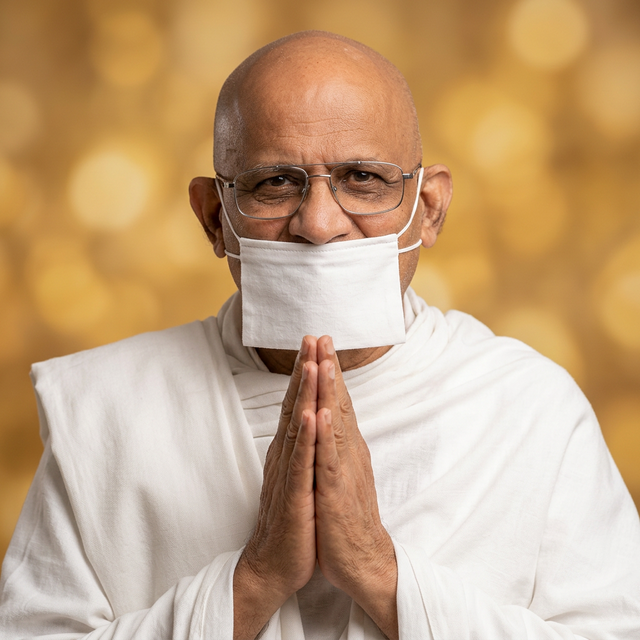
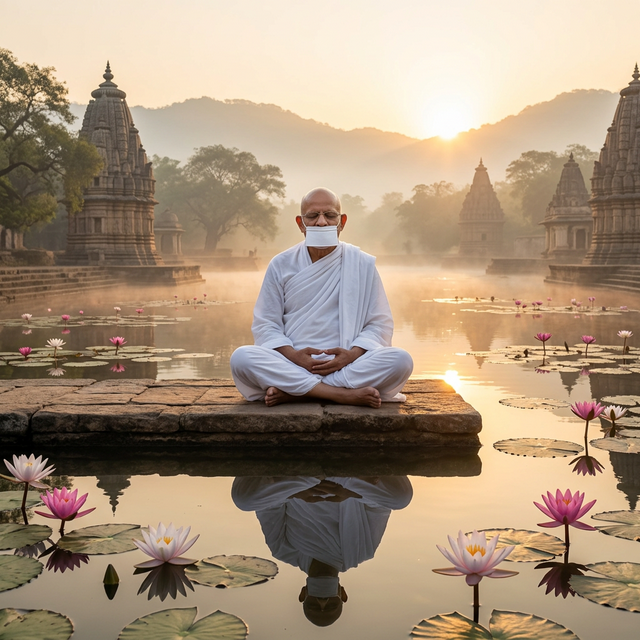
Dhiraj Muni Biography
Chronological Archive

The Biographical
Record

An exhaustive, deeply detailed exploration of the life, choices, disciplines, and relentless service of one of the most significant spiritual figures of our era.

0Walked Barefoot Across India
0Unbroken Daily Meditation
0Material Possessions Owned
0Dietary Discipline (Ekashana)
Early life of Dhiraj Muni
The Beginning

Born into Tradition,
Drawn Toward Truth

Dhiraj Muni was born into a deeply orthodox Jain household embedded within a culturally rich and traditional community. From his earliest years as a child, the patterns that distinguish him from the ordinary were conspicuously evident. While contemporaries pursued academic accolades, social games, and the ordinary aspirations of boyhood, young Dhiraj was irresistibly drawn to the quiet corners of the household temple.

He spent long hours in solitary contemplation, listening to wandering monks and scholars speak of the impermanence of the world. He questioned relentlessly — What is the self? What is the purpose of suffering? What lies beyond birth and death? These were not abstract philosophical games; they were burning, existential necessities.

By the time he reached adolescence, the decision was already forming silently within him — not to pursue the life of a householder, but to follow the uncompromising path of complete renunciation.

Chronology

The Timeline of Ascent

Each phase of Dhiraj Muni's life represents a profound deepening of commitment — to truth, to renunciation, and to the service of all living beings.

Phase I

The Great Renunciation (Diksha)

In a ceremony witnessed by thousands, Dhiraj Muni formally accepted the monastic vows of the Jain tradition. This meant pulling out his hair by the roots with his bare hands (Kesh Lochan) — a symbolic severing from all ego and worldly identity. He renounced ownership of all material objects, familial bonds, and the right to cook or prepare food. He stepped into a life from which there was — and remains — no return.

Phase II

Scholastic Mastery of Lost Scriptures

Mastering the ancient Ardhamagadhi and Prakrit dialects — languages in which the original Jain Agamas (canonical scriptures) were written — allowed Dhiraj Muni to decipher texts that had been impenetrable to mainstream scholars for centuries. Over years of relentless study combined with experiential meditative practice, he produced definitive annotations, translations, and expansion commentaries on dozens of these foundational texts.

Phase III

Mass Public Discourse

Transitioning from isolated scholastic practice to active public engagement, he began delivering discourses to massive congregations. His unique gift lay in translating extremely complex metaphysical concepts — karma, soul transmigration, the mechanics of liberation — into vivid, relatable, actionable insights that ordinary people could immediately apply to the problems of modern life.

Phase IV
Dhiraj Muni

Institutional Architecture at Scale

Armed with a vast network of inspired lay followers and donors, Dhiraj Muni guided the architectural construction of a vast charitable empire — hospitals, schools, animal sanctuaries, ecological programs, and food kitchens — all operating simultaneously. He does not manage these from an office; his instructions are given during audiences and through trusted administrative disciples who carry out his vision on the ground.

In Depth

The Disciplines That Define Him

Explore the rigorous ascetic practices that form the bedrock of Dhiraj Muni's extraordinary life.

On specific days and for extended periods, Dhiraj Muni practices Maun — the complete cessation of all verbal communication. For a figure who is primarily known for discourse and teaching, these periods of silence are remarkably powerful. He communicates, when necessary, through gestures and pre-written notes. The practice is rooted in the understanding that speech is our primary vehicle of ego expression. By systematically silencing the ego's external voice, the inner voice of the soul becomes distinctly audible. Practitioners who have observed him in extended Maun attest to an almost tangible stillness that emanates from his presence during these periods — a quality of absolute peace that is described as deeply contagious and healing.

Dhiraj Muni subsists on a single meal taken before midday, and that meal is obtained exclusively through Gochari — the traditional practice of accepting food from householders who offer it willingly and spontaneously. He carries no vessels of his own; food is placed directly into his cupped hands. The meal is consumed standing, within a fixed time limit, without any expression of preference or displeasure. He accepts what is given, from wherever it comes, without attachment to taste, quantity, or quality. This practice has been maintained for over four continuous decades. It is a daily practical demonstration of Aparigraha (non-possessiveness) and a profound act of systemic trust in the universe's provision.

Jain monastic tradition forbids the use of motorized transport. Dhiraj Muni has walked barefoot — through summer heat with roads reaching 60°C, through monsoon rains and flooding paths, through winter frost — for over 50,000 kilometers across the Indian subcontinent. His Vihar (wandering journey) is not purposeless; it is systematic — traveling from community to community, spending pre-designated periods in specific cities or ashrams, delivering discourse series, overseeing institutional projects, and then moving on. The barefoot walk across scorching asphalt is never spoken of as hardship. It is a practice of humility and a constant reminder of human fragility in the face of nature's raw power.

During Diksha (formal initiation) and periodically throughout monastic life, Dhiraj Muni removes his own hair by pulling it out in clumps with his bare hands — refusing the use of a razor, scissors, or any tool. This practice, known as Kesh Lochan, is simultaneously a ritual of extreme physical discipline, a psychological destruction of vanity and ego, and a public statement of complete disregard for conventional social norms around appearance and self-presentation. It is considered an act of the highest spiritual courage and is performed in full public view as a teaching for the assembled community about the nature of the ego and its deep attachment to the physical body.

Despite overseeing charitable organizations with budgets running into tens of millions of rupees annually, Dhiraj Muni benefits personally from none of it. He accepts no salary, no personal fund, no ownership stake, and no physical gift. His organizational role is entirely that of a spiritual director — setting vision, inspiring donors, validating projects, and maintaining their alignment with the principles of non-violence and non-possessiveness. All property, assets, and financial resources belong formally to charitable trusts governed by elected lay committees. He is the architect but never the owner of a single stone.

Global Recognition

Honors, Engagements & International Acclaim

International Peace Conventions

Invited keynote speaker at interfaith peace assemblies across India, Europe, and North America. His address on Anekantavada as a framework for global political reconciliation has been widely cited.

Academic Collaborations

His translations and commentaries on ancient Agamas are prescribed texts in multiple university postgraduate programs studying Jain philosophy, comparative religion, and classical Indian languages.

Government Partnerships

State governments have collaborated with his charitable trusts to jointly operate relief operations during droughts, floods, and epidemics — deploying the organizational infrastructure he has built over decades.